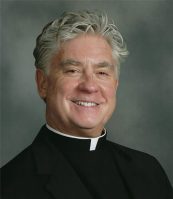
Some people think that priests who get assigned to inner-city ministries are being punished. Their comments give them away: “You must have done something awfully bad to get sent to the ghetto” or “The bishop must really have something against you to send you back there.” Though I have done some bad things in life and it’s possible that some bishops disliked or were disappointed in me, there is no correlation between those realities and my ministry in Kansas City’s urban core churches.
Rather, I identify with many churchgoers who choose to worship in urban centers of America because they believe that is where God dwells—or we can recognize the presence of God more readily there. We drive by many churches to get from our suburban homes or exurban communities to arrive at the heart of the city on Sundays because we recognize it to be holy ground. There, the need is greater; so, there, we think the response should be stronger. I am there because that’s where I feel called to be. I take up the tagline of my alma mater, Rockhurst University: “In the City for Good.” It implies a dedicated presence both for the long term and for its betterment.
Unfortunately, not many diocesan priests are interested in serving the gut of the city amidst low-income housing, high crime and insurance rates, food deserts, and other notorious struggles. Also, unfortunately, not many Catholics live there. Since the bishop must send priests where the Catholics are, it may appear that the church has fled. I am assigned to three small inner-city parishes that are holding on and making a difference “for the good.” I cannot get to all three of them each Sunday because of overlapping Mass times, so other willing priests preside when they’re available. But with a shortage, we sometimes end up “priestless” for Sunday morning worship gatherings. In those cases, parishioners step in to lead prayer: scripture, songs, spiritual reflection, petitions, communion, blessings, etc. Every time it occurs, it brings grace to that community. And sometimes I must depart one Mass early to get to another church for another one on time; in those instances, congregants know which liturgy parts the priest must lead and which parts they can lead—so we shuffle them around a bit. People are happy to realize that they can worship (and often in more meaningful ways) without a priest. It has been going on in many parts of the world for generations.
Though I don’t know what the future holds for urban core churches, I am very pleased that those who gather there on Sundays do so in ways that usher in the future. They are people who don’t tend to get bogged down with religious doctrine, dogma, rules, or rubrics in ways that some others do, people who are not there just to fulfill an obligation but to celebrate their faith with a beloved community, people who willingly step up to lead and serve when called to do so. Wherever people gather in Christ’s name, with or without an ordained cleric, God is present. The central city truly is holy ground, and God dwells in the midst of it. I invite you to come and experience it. Come into the core of our city for its good and maybe you’ll discover it is for your good, too.
Masses each weekend at Saint Francis Xavier (52nd and Troost) are 4:00 Saturday, 8:00 and 10:30 on Sunday…at Saint Therese Little Flower (58th and Euclid) on Sunday at 9:00…and at Saint James (39th and Troost) on Sunday at 10:00
 UPON THIS ROCK
Fr. D
LikeLike
Well said Don! This ought to be sent to every parishioner in a suburban or ex-urban parish. It may get them to thinking outside the box! How about social media of those parishes??? Joni Dugan
LikeLike
Thank you Fr. Don for your service to our parishes. My grandparents were a rural farming family that would hitch up horses and plug through miles of snow to meet our Lord in Mass. I’ve am grateful to have the opportunity to attend mass at least weekly. Let us continue to pray for vocations to the religious life. The harvest is ripe but the workers are few.
Kevin Burdick
+JMJ+
LikeLike
Very well said and explained, although I already knew this .we are currently involved with both St Francis and St Theresa! Jan C
LikeLike
f
LikeLike
Thanks for explaining how you are making three parishes function as places where God truly dwells in and through you and his people.
Mary Jo
LikeLike
thank you for explaining so well how you are making three assignments work to create communities where God dwells, both through your ministry and through the faith and commitment of his people in the inner city.
Mary Jo
LikeLike
Thank you for your service, Mary
LikeLike
Thank you for this father Don and for all that you do.
For me Saint Francis Xavier offers so much more than my Sunday mass obligation. It offers many opportunities to better understand and witness my faith but also so many ways to also put that faith into action in areas that are so in need whether that be the inner city or the Immigrant situation.
Jeanne Bates
LikeLike
Fr. Don,
I have done a Sunday Celebration in the Absence of a Priest (SNAP) three times in the last 16 years when a priest was sick or unavailable. My schedule is flexible, so if I could be of assistance, I would be happy to help. I have also done many Communion Services over the years, let me know how or if I can assist you.
Blessings
Paul
LikeLike
Sure—inner-city parishes showing up where the need is thick, people stepping into priestless liturgies. That looks good in a Church-published highlight reel. But let’s not kid ourselves: this isn’t virtue. It’s a band-aid on a rot-pit.
• “Where God is more readily recognized”—really? That’s spiritual selfie language. The field isn’t honored by optics.
• Calling these “holy grounds” because of need? That’s sacrament, not salvation. It elevates poverty into spiritual veneer while ignoring the architecture of injustice that produced it.
• When laypeople re-create Mass without a priest, that’s resilience—or calamity disguised as piety. It’s grace in motion, but also institutional abdication.
If the Church cared about coherence and redemption, it would poison the system of neglect, not applaud the levees holding back systemic collapse. Don’t applaud absence. Abolish the conditions that made those absences necessary.
LikeLike